Tag: Scientists

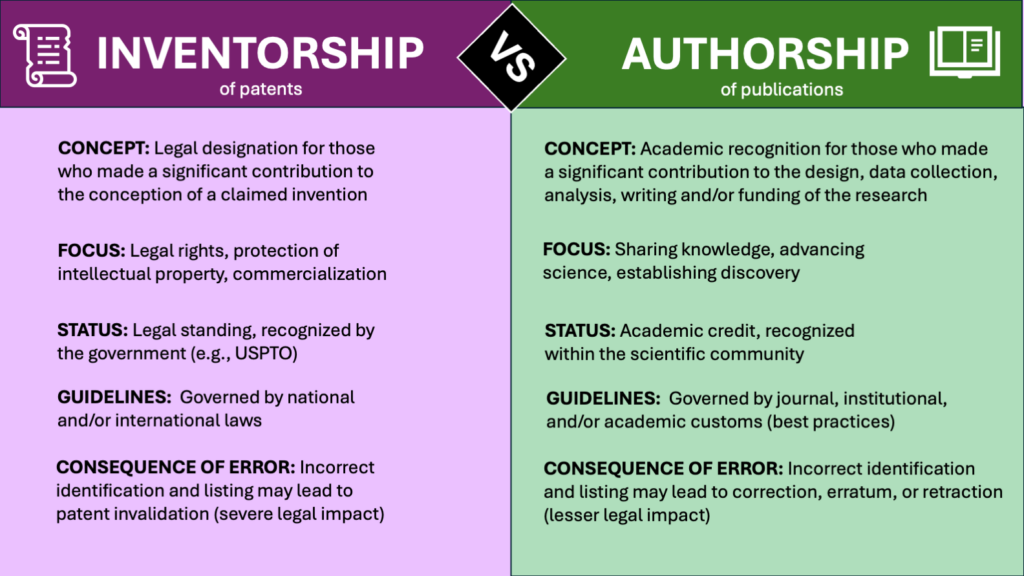
  • Authorship vs. Inventorship

    A table comparing similarities and differences between being an author of a paper and an inventor on a patent

    When I was an Examiner, the absolute worst part of my job was rejecting applications for patents from scientists by using those scientists’ own work against them.  I knew they invented something amazing and I knew they invented what they were asking for legal protection for … but because of the rules that I was required to follow, they could not have a patent for it…

    Ultimately, I have had to reject otherwise brilliant patent applications because the inventors’ provisional application (i.e. “the placeholder”) posted at the Office more than one day AFTER their corresponding journal article’s pre-print posted online.

    If the journal article has additional authors listed (i.e., fairly common because of the different rules for authorship vs. inventorship), then the publication is considered a “different inventive entity” and it is eligible for use as a 102-based art rejection – and usually a slam dunk one at that.

    The “luckier” ones were still in the 1-year grace period, but the “unlucky” ones – were outside of it (i.e. publication more than 1 year prior).

    IP practitioners: What are your best strategies for addressing this situation?
  • Peer Review vs. Patent Examination

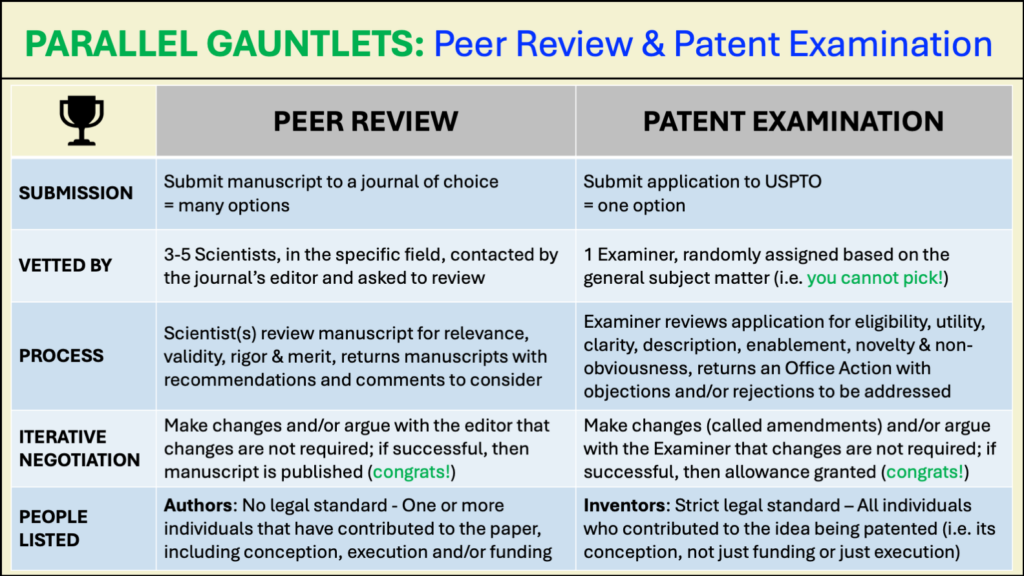
    A table comparing the processes of Peer review for scientific publications and patent examination for patents

    Parallel Gauntlets: Peer Review & Patent Examination

    Here are the similarities (and key differences) between the processes of peer review and patent examination for scientist-inventors applying for a U.S. Patent.

    NOTE: this is an over simplification to get the conversation started between scientists and IP professionals.

    There are many other notable nuances such as:

    -> Turn around time (e.g. manuscripts are generally turned around much faster than applications)

    -> Data requirement (e.g. most manuscripts are scrutinized for proper statistics, whereas applications may rely on as little as prophetic examples)

    -> Length (e.g. manuscripts must conform to the journal’s length requirements, whereas applications are nearly unlimited)

    -> Appeals (e.g. authors of manuscripts can always try somewhere else, whereas applications have a formal appeal process)

    Can you think of others?

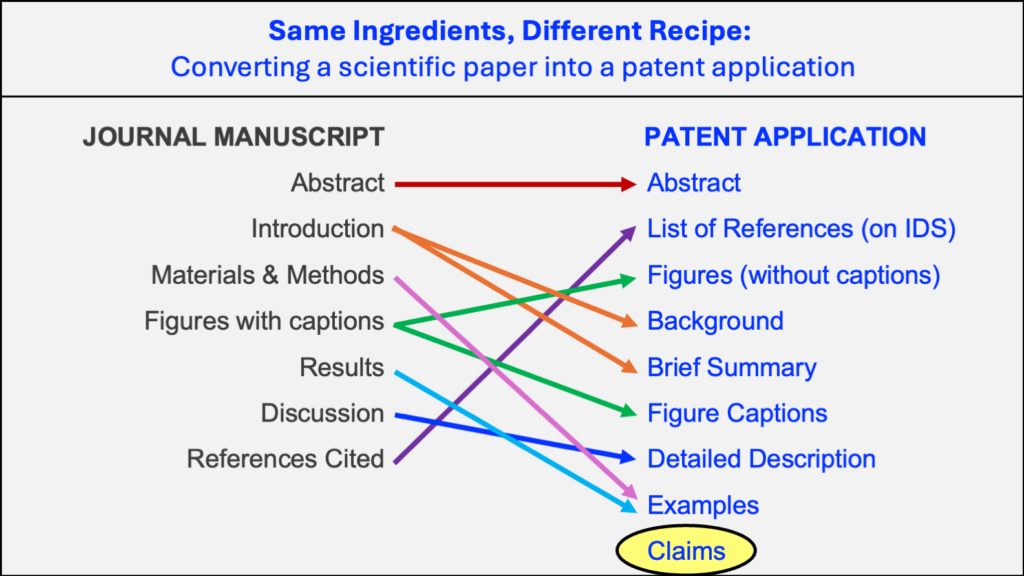
  • Publishing vs. Patenting

    A graphic comparing the parts of a scientific publication to the parts of a patent application to show substantial overlap in the structure of both

    Publish or Patent?

    Many university scientists claim “they don’t have time” to write-up patent applications … which seems true because most are incredibly busy teaching and/or conducting research and/or writing grants and papers.

    But, with the notable exception of writing claims, the work they put into writing a manuscript for publication (i.e. the publish or perish doctrine), can be “cut & paste” into the backbone of a patent application.

    Although the USPTO uses different headings and the sections are in a different order, overall it’s not a doubling of the work. They can be produced in parallel.

    For those of you that work with academics, what other hurdles do you need to overcome to convince them to seek intellectual property protections?

  • QRC for Patent Examination Book

    There are NO Bad Patent Examiners: The unofficial guide to working with the “good” ones.